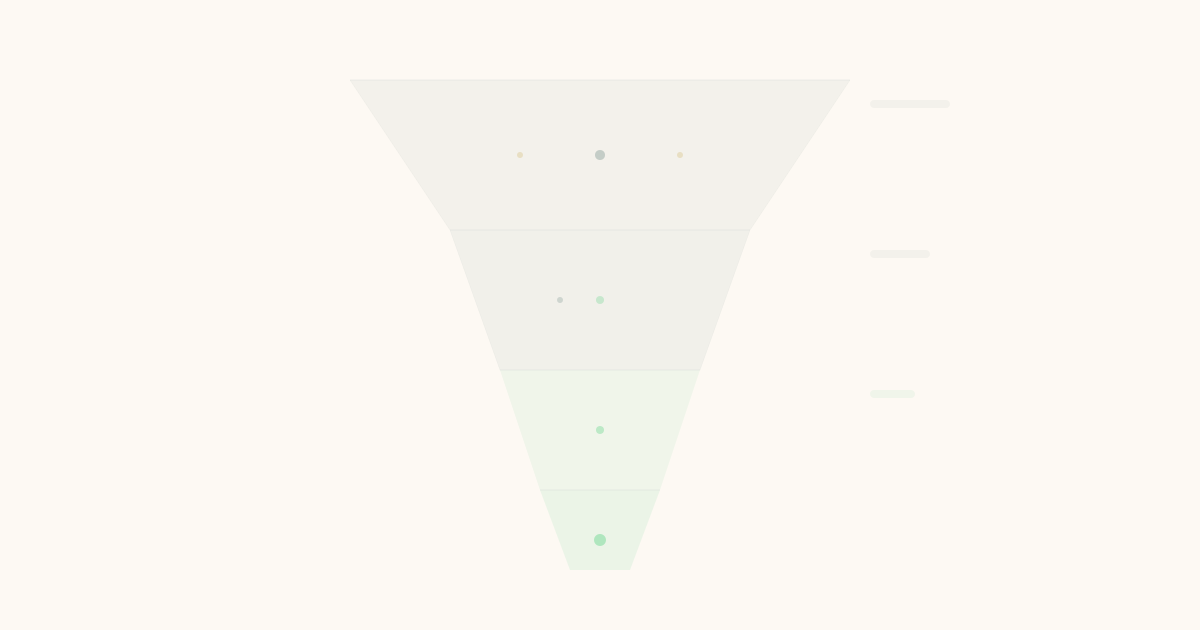

They start with the ads. New creative. Better targeting. A different hook. Maybe a video instead of a static image. They run test after test, spend hours in Ads Manager, and celebrate a 10% improvement in click-through rate.
Meanwhile, the landing page sits untouched. A 15-field form. No mobile optimisation. A headline that doesn't match the ad. And they wonder why cost per lead keeps climbing.
Here's the uncomfortable truth: the biggest conversion lever in your funnel is usually the page the ad sends people to, not the ad.
How one landing page change cut cost per lead by 4.7x
A marketer was hired to fix a client's Google Ads campaigns. The brief was straightforward: ad performance was declining, CPL had crept up to EUR 19, and the client wanted it back under control.
The marketer looked at the ads. They were fine. Not perfect, but fine. Good enough click-through rates. Decent relevance scores. The targeting was reasonable.
Then they looked at the landing page.
A single long-form page with a 15-field lead capture form. Name, email, phone, company, job title, company size, industry, budget range, timeline, and six more fields that most visitors would never bother completing. No progress indicator. No explanation of what happens after you submit. Just a wall of fields and a"Submit" button.
The marketer didn't touch the ads. Instead, they replaced the form with a multi-step quiz funnel.
Same data collection. Same fields, broken into five conversational steps. A progress bar at the top. A"See your personalised results" CTA at the end instead of"Submit your application."
Key Point
CPL dropped from EUR 19 to EUR 4. A 4.7x improvement. Without changing a single ad.
Later, the marketer did go back and overhaul the creative. That added another 1.14x improvement on top. Meaningful, but a fraction of what the landing page change delivered.
The maths tells the whole story. The landing page change was worth 4.7x. The ad creative change was worth 1.14x. If you only had time to do one, there's no contest.
Landing page conversion rate vs ad creative: where to optimise first
Let's make this concrete.
Say you're spending EUR 5,000 per month on ads. Your ads get a 2% click-through rate and your landing page converts at 3%. That gives you roughly 30 leads per month at EUR 167 per lead.
Scenario A: You improve your ad creative. Click-through rate goes from 2% to 2.5%. You get more clicks for the same spend, but the landing page still converts at 3%. Your CPL drops to about EUR 133. A solid 20% improvement.
Scenario B: You improve your landing page. The click-through rate stays at 2%, but the landing page conversion rate goes from 3% to 6%. Your CPL drops to EUR 83. A 50% improvement.
Scenario C: You do both. CPL drops to about EUR 67. But notice where the compounding happens. The landing page improvement does most of the heavy lifting.
| Scenario | CPL | Improvement |
|---|---|---|
| Baseline (2% CTR, 3% CVR) | EUR 167 | -- |
| A: Better ad creative (2.5% CTR) | EUR 133 | 20% |
| B: Better landing page (6% CVR) | EUR 83 | 50% |
| C: Both improvements | EUR 67 | 60% |
This is how the maths works every time. Ad creative improvements are additive. Landing page improvements are multiplicative.
Why landing pages compound
Every click you pay for lands on the same page. If that page converts twice as many visitors, every ad, every keyword, every audience segment benefits. A better landing page amplifies everything upstream. A better ad, by contrast, only affects one variable.
Quiz funnels vs lead forms: same data, higher conversion rate
The quiz funnel isn't a new idea. But it's having a moment, and for good reason. It works because it aligns with how people actually behave online.
A traditional lead form asks the visitor to do work upfront with no clear reward. Fill in your details, hit submit, and maybe someone will email you back. It's a transaction where all the effort is on the visitor's side.
A quiz funnel flips this dynamic. It gives before it asks.
What makes quiz funnels work
Progress and momentum. Each step is small and easy. A progress bar shows you're moving forward. The psychological commitment deepens gradually rather than hitting the visitor with everything at once.
Curiosity and payoff."See your personalised results" is a fundamentally different promise than"Submit your application." One offers something to the visitor. The other asks them to hand over their data and wait.
Lower perceived effort. Five screens with two questions each feels lighter than one screen with ten fields, even though the total data collected is identical. The experience of effort matters more than the actual effort.
Self-qualification. Each question helps the visitor identify their own needs. By the time they reach the final step, they've already convinced themselves they have the problem your product solves. You didn't have to sell them. The quiz did.
Better data quality. Paradoxically, quiz funnels often collect more accurate information than long forms. When people feel engaged rather than burdened, they answer more honestly. And because each question appears in context, the answers tend to be more thoughtful.
The structure of an effective quiz funnel
A quiz funnel typically follows this pattern:
Opening question
Broad, easy, and relevant to the visitor's situation."What best describes your role?" or"How many campaigns are you currently managing?" This lowers the barrier to entry and starts the momentum.
Qualifying questions
Two to three questions that narrow down the visitor's needs. These feel like the quiz is personalising itself to them.
Commitment question
Something slightly more specific, like budget range or timeline. By now, the visitor is invested. They've already answered three questions. Stopping feels like a waste.
Contact capture
Email and name, positioned as the final step before seeing results. Not as an application. Not as a form submission. As the step that gets them their personalised output.
Results or next step
A tailored recommendation, a score, or a specific resource. Something that justifies the quiz and makes the visitor feel like the exchange was fair.
The beauty of this structure is that you end up with the same lead data as your old 15-field form. But the conversion rate can be two to five times higher because the experience respects the visitor's time and attention.
When to optimise your landing page before touching your ads
Not every account needs a landing page overhaul. Sometimes the ads really are the problem. But more often than you'd think, the page is the bottleneck.
Here's a diagnostic checklist. If you check three or more of these boxes, start with the landing page.
The landing page diagnostic
- Your form has more than five fields. Every field you add reduces completion rates. If you're asking for information you don't immediately need to qualify the lead, remove it.
- There's no progress indicator on multi-step forms. Visitors need to know how much effort remains. Without a progress bar, each new step feels like a surprise.
- Your mobile conversion rate is significantly lower than desktop. Most paid traffic, especially from Meta, is mobile. If your page wasn't designed for a thumb, you're losing the majority of your visitors.
- The headline on the page doesn't match the ad. This is called"message match," and it's one of the most common mistakes. If your ad promises"Get a free audit of your Google Ads account" and the landing page headline says"Welcome to our marketing agency," you've broken the visitor's trust before they've even scrolled.
- You're using a generic"Contact Us" or"Submit" CTA. These tell the visitor nothing about what happens next. A good CTA describes the outcome:"See your results,""Get your free report,""Book a 15-minute call."
- Your page takes more than three seconds to load on mobile. Every second of load time costs you conversions. Google's own data shows that 53% of mobile visitors leave a page that takes longer than three seconds to load.
- You haven't looked at your competitor's landing pages recently. Open an incognito window, search for your target keywords, and click the top three ads. If their pages are significantly better than yours, your conversion rate gap isn't a creative problem.
- Your bounce rate from paid traffic is above 70%. If seven out of ten people leave without doing anything, the problem is the page, not the audience.
Rule of thumb
If three or more of these apply, you have a landing page problem. Fix the page first. Then optimise the ads.
How a higher landing page conversion rate improves ad algorithms
There's a second-order effect that most marketers miss.
Modern ad platforms are increasingly algorithm-driven. Meta's Advantage+ campaigns, Google's Performance Max, broad match keywords with Smart Bidding. These systems optimise toward conversions. The better your conversion data, the better the algorithm performs.
A landing page that converts at 3% sends the algorithm a different signal than one that converts at 8%. With more conversions from the same traffic, the algorithm has more data points to learn from. It identifies patterns faster. It finds similar audiences more efficiently. It allocates budget more effectively.
This creates a virtuous cycle:
- Better landing page converts more visitors.
- More conversions give the algorithm better signal.
- Better signal leads to more efficient delivery.
- More efficient delivery reduces cost per click.
- Lower cost per click, combined with higher conversion rate, compounds into dramatically lower CPL.
This is why the marketer in the earlier example saw such a dramatic drop. The quiz funnel didn't just convert more people. It gave Google's bidding algorithm cleaner, faster conversion data. The algorithm could optimise delivery more effectively because it had more examples of what a converting user looks like.
If you're running broad targeting strategies, and in 2026 you should be, your landing page is the single most important variable for algorithm performance. Broad targeting means you're trusting the algorithm to find the right people. A high-converting page is how you teach it who the right people are. This is also why conversion tracking setup is so critical -- without clean conversion data flowing back, no amount of landing page improvement can help the algorithm learn.
Of course, a better-converting page also means your budget gets spent faster. It's worth keeping an eye on ad budget pacing so you don't blow through your monthly budget in week two -- tools like aubado's Budget Checker can automate that monitoring across Google, Meta, and Microsoft Ads.
7 landing page mistakes that kill your conversion rate
These are the landing page optimisation mistakes that drain budgets without anyone noticing, because the marketers responsible are too busy A/B testing ad thumbnails.
1. Too many form fields
This is the most common and the most expensive mistake. Every additional field reduces form completion rates by roughly 4 to 5 percent. A 15-field form with a 2% conversion rate could become a 5-field form with an 8% conversion rate.
Ask yourself: do you really need their phone number, company size, and job title before your first conversation? Most of that information can be collected later, or inferred from their email domain.
2. No progress indicators
If your form has more than one step, show the visitor where they are."Step 2 of 4" or a simple progress bar. Without it, each new step feels potentially endless, and the visitor's most rational move is to leave.
3. Message mismatch between ad and page
The visitor clicked your ad because something specific caught their attention. If the landing page doesn't immediately reinforce that same message, you've broken the promise.
This doesn't mean the page needs to repeat the ad word for word. But the core offer, the headline, and the visual tone should feel continuous. The visitor should never wonder,"Did I click the right link?"
4. Ignoring mobile experience
This one surprises people. Most marketers design their landing pages on a laptop. Then 80% of their Meta traffic arrives on a phone. Tiny text, forms that require horizontal scrolling, buttons too small to tap. These are conversion problems, not design problems.
Test your landing page on your phone. Actually fill out the form. Time yourself. If it takes more than 30 seconds or requires pinching and zooming, you have work to do.
5. The generic CTA
"Submit.""Contact us.""Get started."
These are placeholder labels, not calls to action. A good CTA answers the visitor's question:"What do I get when I click this?"
Generic (low conversion)
- "Submit"
- "Contact us"
- "Get started"
Specific (high conversion)
- "See your personalised audit"
- "Book a 15-minute call"
- "Get your free report"
The specific version outperforms the generic version every time. Not by a little. By a lot.
6. No social proof near the conversion point
Testimonials, client logos, case study snippets, review scores. Place them near the form or CTA, not buried at the bottom of the page. The moment of conversion is the moment of highest doubt. Social proof reduces that doubt.
7. Slow page speed
A landing page is not a website. It doesn't need your full navigation, your footer with 30 links, or your chat widget. Strip it down. Every element that isn't directly contributing to the conversion is either neutral or harmful.
Faster pages convert better. Full stop.
The conversion rate optimisation order that actually works
If you take one thing from this piece, let it be this: optimise from the bottom of the funnel up, not from the top down.
Fix the landing page first
Remove friction. Reduce fields. Add progress indicators. Match the message to the ad. Consider a quiz funnel.
Then improve the offer
Is the value proposition compelling? Is the visitor getting something in exchange for their information?
Then optimise the ads
Better creative, better targeting, better audiences. These matter. But they matter most when the page is already converting well.
This is partly why we built aubado the way we did -- small, modular apps that handle the ad monitoring and budget tracking side of things, so you can spend your time on work like landing page optimisation that actually moves the needle.
Most marketers do this in reverse. They start with the thing that's most visible (the ad) and ignore the thing that has the most impact (the page).
The marketer who dropped CPL from EUR 19 to EUR 4 didn't have a secret trick. They didn't discover a hidden audience or write a magically persuasive ad. They looked at where the funnel was actually breaking, fixed the foundation, and let the improvement compound through everything above it.
Your ads are probably fine. Your landing page probably isn't. Start there. And once the page is working, let something like aubado keep watch on the ads so you don't have to.
Frequently Asked Questions
Related Resources
Stop optimising in the wrong order
aubado monitors your ad budgets and performance so you can focus on what actually moves the needle. Join the waitlist.
Related Resources
Share this article